 Dr. Deepika Bahri
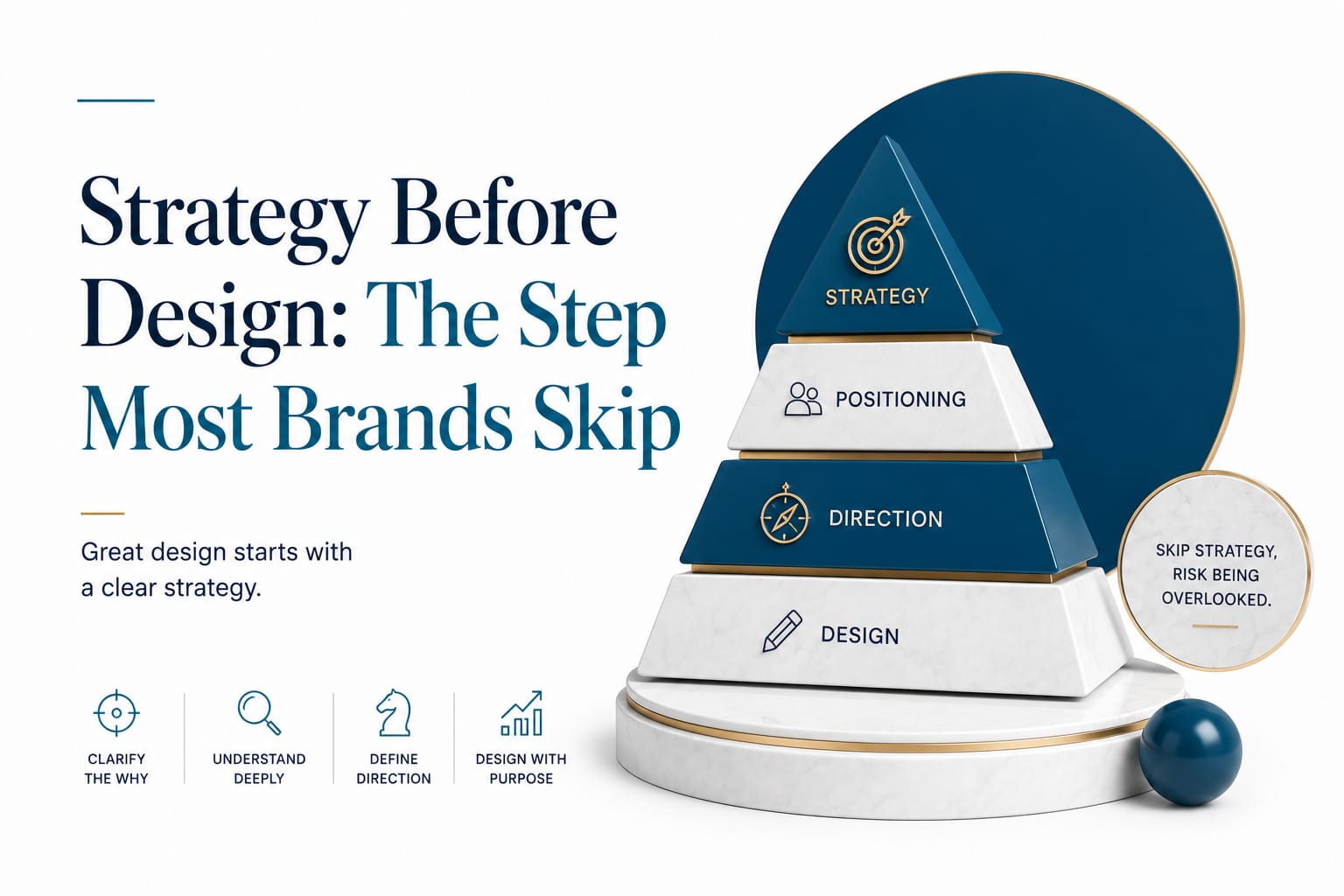
Branding projects often begin with design. Logos, websites, colour systems, and visual refreshes are discussed early—sometimes before the business itself has fully articulated what it wants to stand for.
One of the recurring themes that emerges while reading Brands and Branding is that this order is almost always reversed in successful brands. Strategy precedes expression. Meaning comes before aesthetics.
Yet this is also the step most frequently skipped.
When Design Is Asked to Solve Strategic Gaps
Design is powerful, but it is not diagnostic. When brands jump straight to visuals without addressing positioning, differentiation, or intent, design is forced to compensate for strategic ambiguity.
This is where branding begins to feel superficial—not because design lacks depth, but because it is being asked to do work it was never meant to do.
The book makes it clear that branding is not about making choices look better. It is about making better choices visible.
Why Strategy Is Uncomfortable
Brand strategy demands clarity. It forces organisations to confront difficult questions:
- Who are we really for?
- What do we stand for—and what do we deliberately not try to be?
- Where do we want to compete, and where do we step back?
These are slower conversations. They involve trade-offs. And they cannot be rushed.
Design, by contrast, feels decisive. It produces immediate outputs. This is often why it is prioritised—even when foundations are still shifting.
The Illusion of Progress
One of the quieter warnings in the book is about mistaking activity for advancement. New visuals can create the impression of progress without addressing underlying confusion.
Logos change. Websites refresh. Taglines rotate.
But without strategic clarity, brands keep rebuilding the same uncertainty—just in different colours.
This is not evolution. It is repetition.
Strategy Creates Freedom, Not Constraint
The original author, Rita Clifton, repeatedly frames brand strategy not as a restriction, but as a guide. When a brand knows what it stands for, design becomes easier, faster, and more coherent.
Creativity thrives when it has direction.
Consistency emerges naturally when choices are anchored.
What This Looks Like in Practice
At Antraajaal, a Chandigarh-based branding agency working with businesses across North India, this sequencing often becomes the most valuable intervention.
When strategy is addressed first:
- Design decisions align more easily
- Communication becomes sharper
- Brands stop second-guessing themselves
The result is not just better-looking brands—but brands that hold their ground over time.
Why Skipping Strategy Is Expensive
The cost of bypassing strategy rarely appears immediately. It shows up later as:
- Repeated redesigns
- Inconsistent messaging
- Brand dilution
- Confused teams and audiences
The book reinforces that branding is not about speed. It is about sustainability.
Closing Thought
Design gives a brand form.
Strategy gives it direction.
When the order is reversed, brands may look finished—but remain unfinished.

Written by
Dr. Deepika Bahri
Dr. Deepika Bahri is a passionate Branding and Digital Marketing expert with a Doctorate in Marketing, specializing in Brand Strategy and Digital Transformation. With over Two Decades of experience in the media, advertising, and communication industry, she brings a unique blend of academic insight and real-world business acumen. She has also been honored with an Honorary Doctorate for her contribution to Women Empowerment, recognizing her efforts in mentoring, uplifting, and creating platforms for women-led enterprises. Currently serving as the CEO of Antraajaal, a leading branding and advertising agency, Dr. Bahri is committed to sharing insights on branding, marketing strategy, women leadership, and digital growth through her writing and speaking engagements.
Need Expert Guidance?
Antraajaal builds purpose-led brand identities for serious businesses.
Brand strategy, identity and digital presence — one integrated system, built to lead across North India.
Our Services