 Dr. Deepika Bahri
This blog is Inspired by Brand Desire by Nicholas Ind and Oriol Iglesias which speaks about brand co-creation.
Introduction: The End of Brand Control
For decades, branding was a controlled exercise.
Companies defined:
- The positioning
- The narrative
- The tone
- The identity
Consumers received the message.
That era is over.
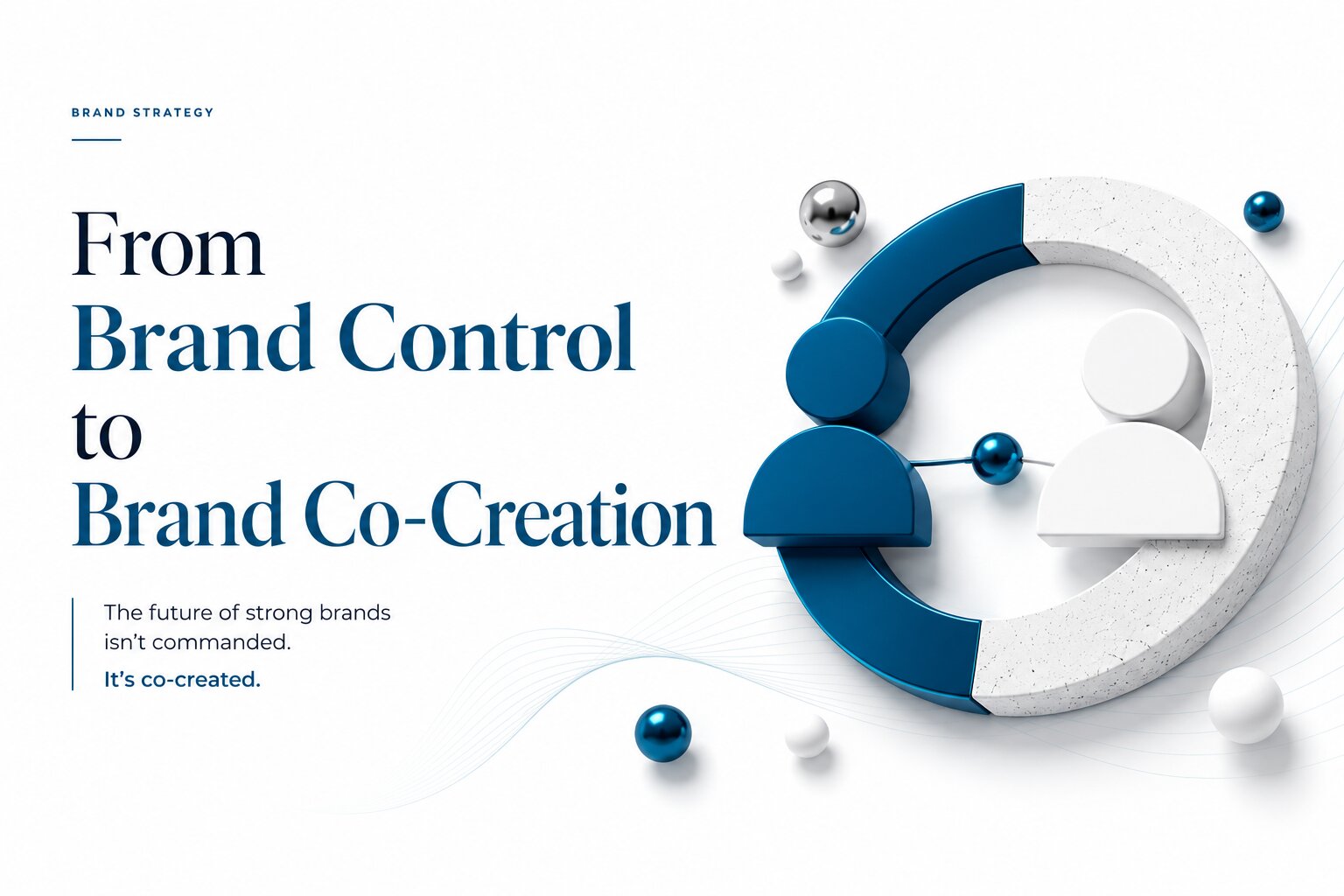
In today’s participatory economy, brands are no longer owned solely by companies. They are co-created with stakeholders — customers, employees, partners, communities, and even critics.
The shift from control to co-creation is not cosmetic. It is structural. And businesses that fail to understand this transition risk becoming irrelevant.
What Is Brand Co-Creation?
Brand co-creation is the process through which meaning is shaped collaboratively between a business and its stakeholders.
It includes:
- Customer feedback shaping product decisions
- Social media dialogue influencing brand voice
- Employee culture defining brand authenticity
- Community values impacting positioning
A brand is no longer what you say.
It is what people experience, interpret, and share.
In a hyperconnected ecosystem, every stakeholder becomes a micro-broadcaster.
The Collapse of the Broadcast Model
Traditional branding relied on:
- Mass media campaigns
- One-way communication
- Centralized message control
Today:
- Reviews influence perception more than ads
- Conversations travel faster than campaigns
- Transparency overrides polish
Take Zomato as an example. Its brand voice evolved through constant digital interaction. Social media wasn’t just a marketing channel; it became a dialogue space where customers shaped tone and personality.
Similarly, companies like Tata Group maintain trust not because of advertising frequency, but because stakeholders continuously validate their ethical positioning.
In both cases, brand meaning is reinforced collectively.
Why Co-Creation Builds Stronger Brands
It Increases Emotional Investment
When customers feel heard, they feel ownership.
It Strengthens Trust
Transparency builds credibility. Control signals insecurity.
It Enhances Innovation
Crowdsourced insights often outperform internal assumptions.
It Reduces Brand Risk
Listening early prevents reputational crises later.
Co-creation does not weaken brand authority.
It deepens brand legitimacy.
The Role of Employees in Brand Co-Creation
One of the most underestimated stakeholders in branding is the employee.
Internal culture is external branding.
If your employees:
- Don’t believe the brand promise
- Don’t understand the brand narrative
- Don’t embody the brand values
Then your external communication collapses.
Modern branding requires internal alignment workshops, belief mapping, and culture audits.
A brand must be lived before it is communicated.
Digital Platforms as Co-Creation Engines
Social media, community platforms, and AI-powered feedback systems have transformed stakeholder participation.
Today:
- Customers suggest features
- Communities influence campaigns
- Users generate content
- Data shapes personalization
Technology enables co-creation at scale.
But digital engagement without strategic intent becomes chaotic.
Co-creation must be guided, not uncontrolled.
Co-Creation vs. Brand Dilution
A common fear among businesses is:
“If we let customers shape the brand, won’t we lose identity?”
The answer depends on clarity.
If a brand has:
- A strong belief system
- Clear values
- Defined positioning
Then co-creation enriches identity.
If a brand lacks strategic clarity, co-creation exposes inconsistency.
The key is not relinquishing direction — it is integrating participation within a clear framework.
The Indian Market: Why Co-Creation Matters More Now
India’s demographic landscape is young, vocal, and digitally expressive.
Gen Z and millennials:
- Expect responsiveness
- Value inclusivity
- Reward transparency
- Reject performative branding
In such an environment, top-down communication feels outdated.
Brands must:
- Invite conversation
- Encourage community
- Show adaptability
- Demonstrate accountability
Indian SMEs, in particular, have a unique advantage — agility. They can adopt co-creation faster than legacy corporations burdened by bureaucracy.
How Businesses Can Implement Brand Co-Creation
Here is a practical framework:
Step 1: Define Non-Negotiables
Clarify core beliefs and brand boundaries.
Step 2: Open Structured Dialogue
Use surveys, social engagement, community forums.
Step 3: Integrate Feedback into Strategy
Not all feedback is useful. Strategic filtration is essential.
Step 4: Empower Employees
Train teams to represent and interpret brand values authentically.
Step 5: Communicate Transparency
Show stakeholders how their input influenced decisions.
Participation without visible impact erodes trust.
The Strategic Role of AI in Co-Creation
AI tools now allow brands to:
- Analyze sentiment patterns
- Track behavioral shifts
- Personalize communication
- Predict stakeholder needs
However, AI must remain a decision-support tool, not a replacement for human empathy.
Co-creation is relational.
Algorithms assist. Humans connect.
The Future: Brands as Living Systems
In the co-creation paradigm, brands function as ecosystems.
They are:
- Dynamic
- Responsive
- Evolving
- Participatory
The brand manager of the future is not a controller — but a curator.
They shape dialogue.
They maintain coherence.
They nurture alignment.
Conclusion: Control Is Illusion. Participation Is Power.
Brand control was an industrial-age concept.
Brand co-creation is a network-age reality.
Modern branding demands:
- Openness
- Cultural sensitivity
- Strategic clarity
- Continuous listening
Businesses that cling to control will struggle.
Those that embrace collaboration will build resilient, meaningful brands.
At Antraajaal, we design branding systems that integrate strategic clarity with participatory engagement — because sustainable brands are not dictated.

Written by
Dr. Deepika Bahri
Dr. Deepika Bahri is a passionate Branding and Digital Marketing expert with a Doctorate in Marketing, specializing in Brand Strategy and Digital Transformation. With over Two Decades of experience in the media, advertising, and communication industry, she brings a unique blend of academic insight and real-world business acumen. She has also been honored with an Honorary Doctorate for her contribution to Women Empowerment, recognizing her efforts in mentoring, uplifting, and creating platforms for women-led enterprises. Currently serving as the CEO of Antraajaal, a leading branding and advertising agency, Dr. Bahri is committed to sharing insights on branding, marketing strategy, women leadership, and digital growth through her writing and speaking engagements.
Need Expert Guidance?
Antraajaal builds purpose-led brand identities for serious businesses.
Brand strategy, identity and digital presence — one integrated system, built to lead across North India.
Our Services