 Dr. Deepika Bahri
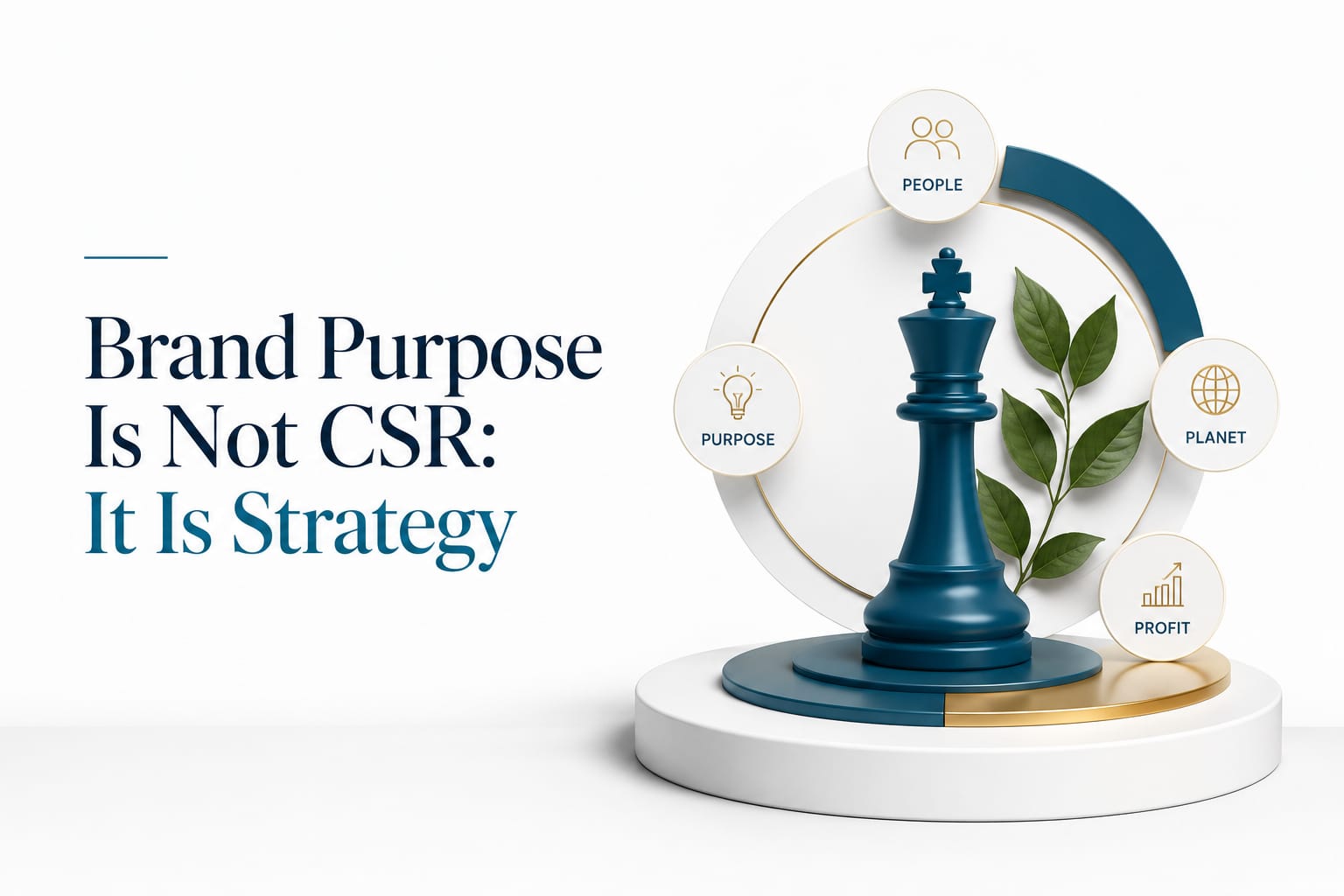
Rethinking Meaningful Branding in the Modern Economy
Purpose has become one of the most overused words in business.
Every brand claims it.
Few embed it.
In Brand Desire, Nicholas Ind and Oriol Iglesias argue that meaningful brands are not built through surface communication, but through deeply integrated belief systems. Purpose is not a marketing department initiative. It is a strategic compass.
And in 2026, businesses that confuse CSR with purpose are being exposed quickly.
CSR vs. Brand Purpose: The Structural Difference
Corporate Social Responsibility (CSR) is often:
- Activity-based
- Campaign-driven
- Budget-allocated
- PR-amplified
Brand purpose, in contrast, is:
- Identity-based
- Decision-informing
- Long-term oriented
- Strategically embedded
CSR asks:
What good can we do alongside business?
Purpose asks:
Why does this business exist in the first place?
This distinction changes everything.
Why Consumers No Longer Accept Superficial Purpose
Modern stakeholders — especially Gen Z and millennials — are highly perceptive.
They can differentiate between:
- Purpose-led strategy
- Purpose-washed communication
In India, where digital literacy and social awareness are accelerating, brand inconsistency is quickly amplified through social platforms.
Consumers today evaluate:
- Supply chain ethics
- Employee treatment
- Leadership integrity
- Environmental positioning
- Social responsiveness
A one-time CSR campaign cannot compensate for systemic misalignment.
Purpose as Competitive Advantage
When purpose is embedded strategically, it influences:
1️⃣ Product Development
Purpose shapes innovation priorities.
2️⃣ Talent Acquisition
Purpose attracts value-aligned employees.
3️⃣ Customer Loyalty
Purpose builds emotional attachment beyond price sensitivity.
4️⃣ Long-Term Equity
Purpose stabilizes brand identity during market volatility.
Consider how Tata Group has historically anchored its operations around trust and nation-building. This positioning is not communicated occasionally — it is structurally integrated.
Purpose becomes durable when it informs decisions, not just campaigns.
The Economic Case for Purpose
Purpose is not philanthropy.
It is strategic risk mitigation and long-term value creation.
Businesses that operate without a defined ethical framework face:
- Reputational crises
- Talent attrition
- Consumer distrust
- Regulatory backlash
Purpose reduces ambiguity.
It creates strategic coherence.
In a volatile economy, coherence is stability.
The Indian Context: Purpose in a Rapidly Evolving Market
India’s market landscape is uniquely positioned.
- Young demographic
- Entrepreneurial ecosystem
- Digital transformation
- Rising social consciousness
Brands operating in India must navigate:
- Cultural diversity
- Socio-economic disparity
- Rapid technological adoption
- Environmental challenges
Purpose in India cannot be imported from global templates.
It must be contextually rooted.
For Indian SMEs, especially, purpose is a differentiator. It enables smaller brands to compete against large corporations by building stronger emotional bonds.
Purpose and Business & Human Rights
Purpose-driven branding intersects directly with:
- Ethical governance
- Gender equity
- Inclusive employment
- Responsible communication
- Community empowerment
A purpose-led brand does not react to societal issues.
It anticipates them.
This requires leadership vision.
Purpose cannot be delegated to marketing teams alone. It must originate from leadership philosophy.
The Internal Alignment Imperative
The greatest risk in purpose branding is internal misalignment.
If:
- Employees do not understand the brand’s values
- Leadership behavior contradicts stated beliefs
- Operational decisions ignore ethical commitments
Then purpose becomes liability rather than strength.
Embedding purpose requires:
- Culture workshops
- Strategic audits
- Stakeholder mapping
- Clear articulation of non-negotiables
Purpose must be operationalized.
How to Embed Brand Purpose Strategically
Here is a practical framework:
Step 1: Define Your Foundational Belief
What systemic tension does your brand respond to?
Step 2: Translate Belief into Business Decisions
Does it influence pricing, partnerships, hiring, product design?
Step 3: Align Internal Culture
Purpose must be experienced internally before communicated externally.
Step 4: Communicate Transparently
Share both progress and limitations.
Step 5: Measure Impact
Purpose without measurable accountability becomes rhetoric.
The Risk of Purpose-Washing
Purpose-washing occurs when brands:
- Use emotional narratives without operational backing
- Align temporarily with trending social causes
- Overpromise impact
- Under-deliver commitment
The market penalizes inconsistency more harshly than silence.
Authenticity is now measurable through public scrutiny.
The Future of Brand Strategy
Brand purpose will increasingly determine:
- Investment decisions
- Consumer preference
- Talent mobility
- Regulatory frameworks
In the coming decade, businesses without clear ethical positioning will struggle to build long-term trust.
Purpose is no longer optional.
It is infrastructural.
From CSR Activity to Strategic Identity
The shift businesses must make is clear:
From:
“We support a cause.”
To:
“Our business model reflects our cause.”
That transformation requires strategic clarity, leadership conviction, and systemic integration.
At Antraajaal, we approach branding as a belief-driven system — aligning narrative, culture, and strategy. Because in the era of heightened awareness, purpose is not a campaign.
It is a commitment.

Written by
Dr. Deepika Bahri
Dr. Deepika Bahri is a passionate Branding and Digital Marketing expert with a Doctorate in Marketing, specializing in Brand Strategy and Digital Transformation. With over Two Decades of experience in the media, advertising, and communication industry, she brings a unique blend of academic insight and real-world business acumen. She has also been honored with an Honorary Doctorate for her contribution to Women Empowerment, recognizing her efforts in mentoring, uplifting, and creating platforms for women-led enterprises. Currently serving as the CEO of Antraajaal, a leading branding and advertising agency, Dr. Bahri is committed to sharing insights on branding, marketing strategy, women leadership, and digital growth through her writing and speaking engagements.
Need Expert Guidance?
Antraajaal builds purpose-led brand identities for serious businesses.
Brand strategy, identity and digital presence — one integrated system, built to lead across North India.
Our Services