 Dr. Deepika Bahri
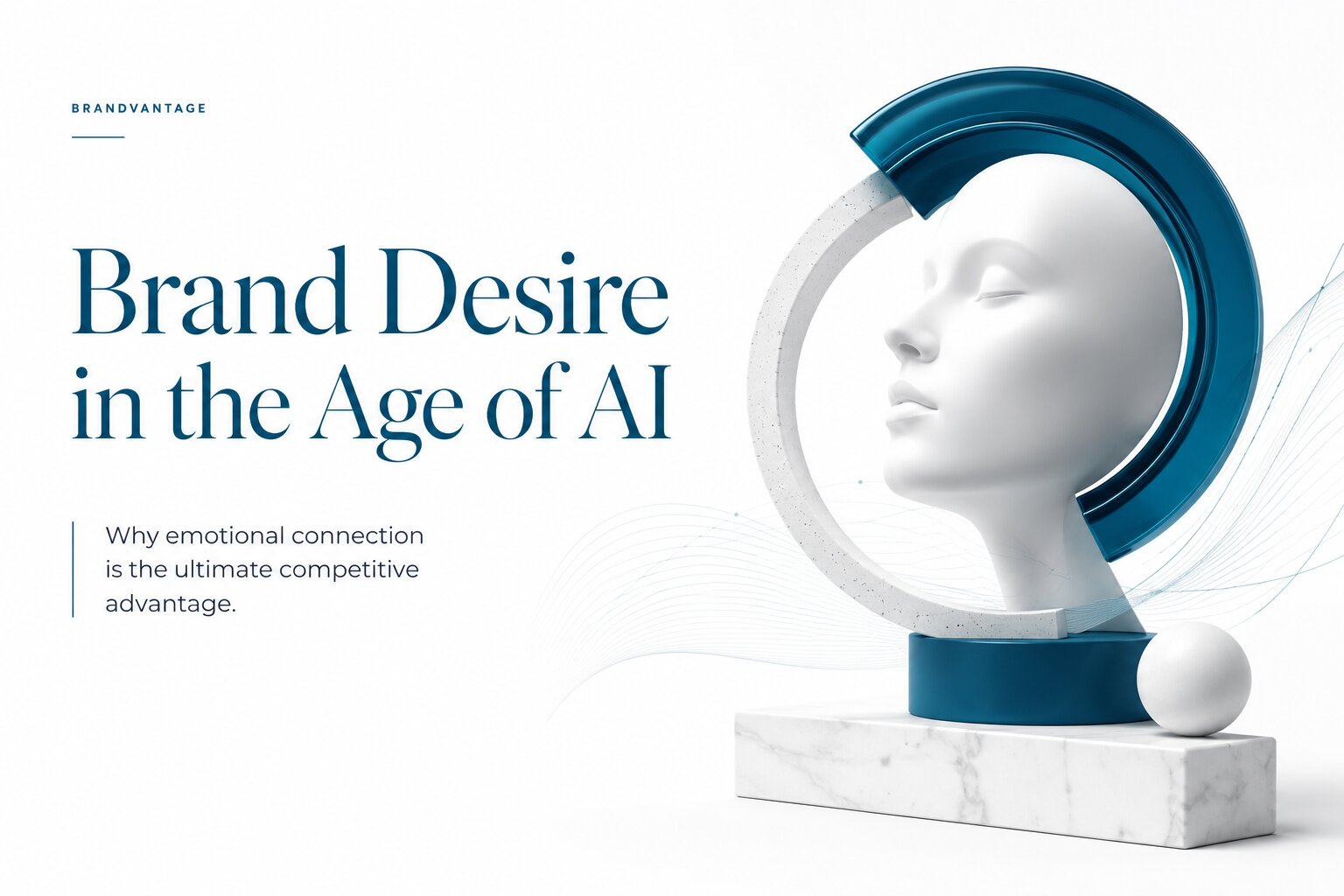
We are living in the most data-rich era in human history.
Every click, scroll, search, pause, and purchase leaves a digital footprint. Artificial Intelligence can now predict behaviour, personalise communication, and optimise engagement at scale.
But here is the fundamental question:
Can technology create brand desire?
Or can it only amplify it?
Inspired by the ideas in Brand Desire by Nicholas Ind and Oriol Iglesias, this blog explores the intersection of AI, psychology, and emotional branding — and what it means for businesses in 2026 and beyond.
The New Branding Reality: Data Is Abundant. Attention Is Scarce.
AI has transformed marketing capabilities:
- Hyper-personalized email journeys
- Predictive product recommendations
- Sentiment analysis
- Behavioral segmentation
- Automated content generation
Platforms like Amazon recommend what you might want before you consciously realize it.
Netflix curates experiences tailored to individual viewing psychology.
These systems increase relevance.
But relevance is not the same as emotional connection.
AI optimizes efficiency.
Desire requires meaning.
What AI Can Do for Brands
AI excels in three critical branding areas:
1️⃣ Precision Targeting
Micro-segmentation enables tailored communication for specific psychographic groups.
2️⃣ Predictive Insight
Brands can anticipate needs before customers articulate them.
3️⃣ Real-Time Optimization
Campaigns can adjust dynamically based on performance signals.
This reduces waste, improves ROI, and enhances personalization.
However, AI operates on patterns.
Emotion operates on narrative.
What AI Cannot Do Alone
AI cannot:
- Define brand belief systems
- Establish moral positioning
- Build authentic culture
- Experience empathy
- Interpret cultural nuance intuitively
Brand desire is built when a brand stands for something beyond transactional value.
Technology can deliver the message more efficiently — but it cannot determine what the message should fundamentally represent.
Emotional Branding in an Algorithmic World
Consumers today expect personalization — but they also expect authenticity.
If personalization feels invasive, trust declines.
If automation feels robotic, connection weakens.
This creates a paradox:
The more technology brands use, the more human they must become.
Emotional branding requires:
- Consistent narrative
- Ethical clarity
- Transparent communication
- Cultural awareness
AI can amplify storytelling.
It cannot replace storytelling intent.
The Risk of Over-Automation
Many businesses are now:
- Automating responses
- Generating mass AI-written content
- Using predictive persuasion
- Relying solely on performance metrics
The result?
Efficiency without identity.
When every brand uses similar AI tools without strategic differentiation, communication becomes homogenized.
Desire fades in uniformity.
Brands must avoid becoming algorithmically optimized but emotionally empty.
The Indian Market and AI-Driven Branding
India is experiencing rapid digital acceleration.
AI adoption in marketing is rising across:
- E-commerce
- EdTech
- FinTech
- D2C brands
- Healthcare marketing
But Indian consumers are deeply rooted in cultural identity, community values, and relational trust.
A purely algorithmic brand strategy will not resonate.
AI-driven personalization must be combined with:
- Cultural storytelling
- Value-driven messaging
- Regionally nuanced communication
Technology without cultural intelligence is ineffective.
Integrating AI with Brand Meaning: A Strategic Framework
To build brand desire in the age of AI, businesses should follow this model:
Step 1: Define Core Belief
What does your brand stand for — ethically and socially?
AI cannot define this.
Step 2: Map Emotional Drivers
Identify psychological triggers:
- Aspiration
- Security
- Belonging
- Status
- Purpose
Step 3: Use AI for Amplification
Deploy AI to:
- Segment audience clusters
- Personalize delivery
- Track sentiment trends
- Optimize content timing
Step 4: Maintain Human Oversight
Ensure brand voice remains:
- Empathetic
- Consistent
- Context-aware
AI should enhance strategic clarity, not override it.
AI, Ethics, and Brand Trust
As AI becomes more integrated into branding, ethical responsibility increases.
Consumers are increasingly aware of:
- Data privacy
- Algorithmic manipulation
- Deepfake marketing
- Emotional exploitation
Brands must ensure:
- Transparent data policies
- Honest communication
- Responsible personalization
- Non-manipulative persuasion
Desire built on deception collapses quickly.
Trust remains the foundational currency of branding.
The Hybrid Future: Human Strategy + Machine Intelligence
The future of branding is not AI versus human creativity.
It is AI plus human intentionality.
Successful brands will:
- Use AI for analytical depth
- Use human insight for emotional depth
- Combine data intelligence with storytelling mastery
- Align automation with authenticity
The brand strategist of the future must understand both behavioral psychology and technological systems.
From Attention Economy to Desire Economy
AI dominates the attention economy.
But brand desire operates at a deeper psychological level.
Attention is captured.
Desire is cultivated.
Technology accelerates visibility.
Meaning sustains loyalty.
Businesses that mistake algorithmic optimization for brand building will struggle to create long-term equity.
Those that integrate AI within a strong belief-driven framework will build durable emotional capital.
Conclusion: Can Technology Create Emotional Connection?
Technology can facilitate connection.
It cannot originate it.
Brand desire begins with:
- Purpose
- Belief
- Cultural relevance
- Human empathy
AI refines delivery.
In 2026 and beyond, the competitive advantage will not belong to brands that use the most advanced technology — but to those that integrate technology with meaning.
At Antraajaal, we view AI as a strategic enhancer, not a substitute for emotional architecture. Because in the age of algorithms, humanity becomes the ultimate differentiator.

Written by
Dr. Deepika Bahri
Dr. Deepika Bahri is a passionate Branding and Digital Marketing expert with a Doctorate in Marketing, specializing in Brand Strategy and Digital Transformation. With over Two Decades of experience in the media, advertising, and communication industry, she brings a unique blend of academic insight and real-world business acumen. She has also been honored with an Honorary Doctorate for her contribution to Women Empowerment, recognizing her efforts in mentoring, uplifting, and creating platforms for women-led enterprises. Currently serving as the CEO of Antraajaal, a leading branding and advertising agency, Dr. Bahri is committed to sharing insights on branding, marketing strategy, women leadership, and digital growth through her writing and speaking engagements.
Need Expert Guidance?
Antraajaal builds purpose-led brand identities for serious businesses.
Brand strategy, identity and digital presence — one integrated system, built to lead across North India.
Our Services