 Dr. Deepika Bahri
The Machine Will Draw You Anything
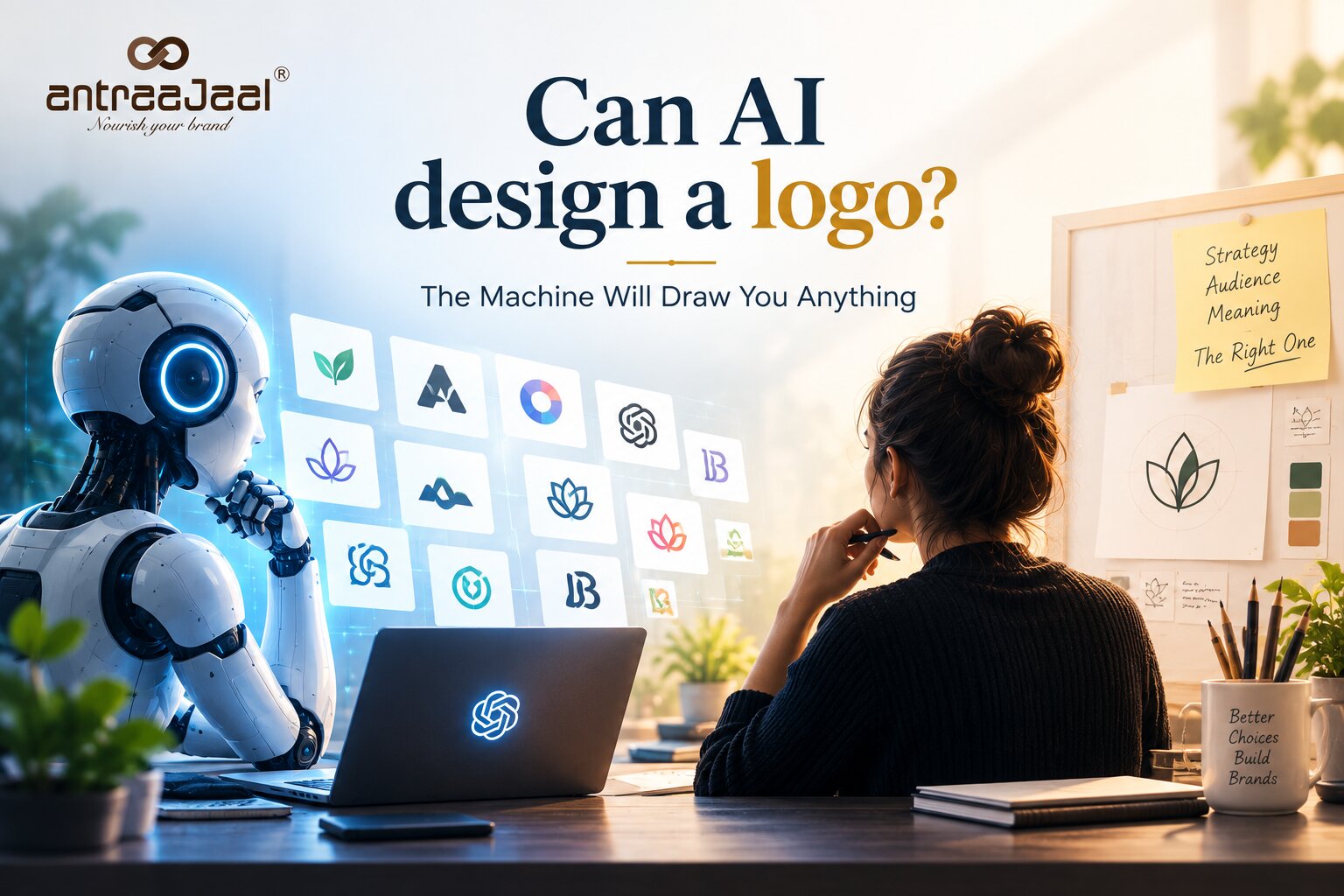
Can AI design a logo? Yes. Which is exactly why that’s the wrong question.
A friend texted me at midnight, buzzing.
“I MADE MY LOGO. Took like 30 seconds!!”
Then, in a rapid burst, the evidence: screenshot after screenshot of AI-generated marks. Clean ones, bold ones, a few genuinely lovely ones. A hundred logos, maybe more, conjured out of a single sentence typed into a box, faster than it takes to boil water.
I wrote back the next morning. “These are great. Which one are you using?”
Three dots appeared. Disappeared. Appeared again.
An hour later: “…that’s kind of the problem, isn’t it.”
Yes. That is exactly the problem. And it’s the whole story of AI and logos, sitting right there in a stalled text thread.
Let’s be honest about what the machine can do
I’m not going to be the designer who sneers at this. That designer is wrong, and looks more wrong every month.
The tools have become genuinely, startlingly good. The old giveaway — AI that couldn’t spell, that mangled letters into alien gibberish — is mostly gone; the leading models now set real type, real words, reliably. They’ll generate a hundred directions in the time it takes to describe one. They cost almost nothing. And for the messy, magical early stage of a project — when you don’t yet know what you want and need to see things to find out — they are a spectacular sketchbook. A tireless brainstorm partner that never gets bored, never gets precious, and never charges you for a second draft.
If you’re not using AI to explore, you’re working with one hand tied behind your back. Genuinely.
So no, the question isn’t whether AI can make a logo. It plainly can. The question my friend stumbled into at midnight is the one that actually matters: once you have a hundred logos, how do you know which one is right?
A logo isn’t a picture. It’s a decision.
Here’s the thing the hundred screenshots hide. A logo is not really an image. It’s the end of an argument — the visible answer to a question that lives entirely outside the picture. Why this shape and not that one? Why this feeling? Who is this for, what do they fear, what do they already trust, and what will still be true about them in ten years?
AI can generate the answer. It cannot make the decision — because a decision needs a reason, and the reason isn’t in the pixels. It’s in the business. That’s why a hundred options felt like freedom for thirty seconds and a prison by morning. The machine handed my friend a hundred doors and no idea which one to walk through. Generating the doors was never the hard part. Knowing which one — and being able to say why — is the entire job.
Knowing which one — and being able to say why — is the entire job.
That’s also why professional logo design has never really been about simply drawing a symbol.
It is about translating a business into something people can recognise, remember and trust.
The three things it can’t do (yet, or maybe ever)
It says yes to everything. Ask any good designer what their most valuable skill is, and the honest ones won’t say “drawing.” They’ll say “saying no.” Talking a founder out of the clever idea that will embarrass them in two years. AI has no spine and no opinion — it will enthusiastically generate your worst instinct in glorious high resolution, and never once tell you it’s a mistake.
It borrows from the average. AI learns from everything that already exists, which means it drifts, always, toward the middle of what’s already out there. Feed it “modern minimalist logo for a tech startup” and it gives you the visual equivalent of beige — because those are the five most generic words in design, and the machine is a mirror, not a muse. Distinctiveness is precisely the thing an average can’t produce.
It hands you a pretty picture, not a brand. A logo isn’t a JPEG. It’s a system — a mark that has to survive being tiny, being one colour, being embroidered, being alive across a hundred surfaces for a decade. AI often gives you a gorgeous, gradient-heavy image that falls apart the moment you shrink it or try to get a clean vector out of it. And then there’s the quiet legal fog: who actually owns an AI-generated mark, and can you even trademark it? Nobody’s fully sure yet.
The cost was never the drawing
There’s a famous story about the Nike swoosh being made for thirty-five dollars. People love it as proof that great logos are cheap. They’ve got it backwards. The drawing was cheap — it was always cheap. What Nike got for its money, and the millions it was worth later, was judgment: the instinct to choose that one stroke and commit a company to it.
AI has now driven the cost of the drawing all the way down to zero. Wonderful. But that doesn’t make branding free — it does the opposite. When the drawing costs nothing, the thinking becomes the entire value. The strategy, the “no,” the reason, the taste to pick one door out of a hundred and shut the rest. That was always what you were paying for. AI has simply stripped away the pretty distraction and left the real work standing there, exposed.
So — use it. Then do the actual job.
The smartest way to work now isn’t AI or a designer. It’s AI then a designer. Explore wide and fast and cheap with the machine — a hundred doors, no ego, no invoice. Then bring human judgment to the part the machine can’t do: choosing, refining, knowing why, and having the nerve to throw ninety-nine of them away.
My friend and I got there eventually. Not by generating more options — he had far too many already — but by putting the phone down and answering one question the machine had never even asked him: who is this for, and what do you want them to feel?
The answer was never hiding in the hundred pictures. It was hiding in him.
The machine will draw you anything. That’s the wonder of it, and the trap. Because it will cheerfully draw a thousand beautiful things and never once tell you what you actually mean.
That part is still yours.
And that’s exactly where thoughtful design — and a brand like Antraajaal — earns its place.

Written by
Dr. Deepika Bahri
Dr. Deepika Bahri is a passionate Branding and Digital Marketing expert with a Doctorate in Marketing, specializing in Brand Strategy and Digital Transformation. With over Two Decades of experience in the media, advertising, and communication industry, she brings a unique blend of academic insight and real-world business acumen. She has also been honored with an Honorary Doctorate for her contribution to Women Empowerment, recognizing her efforts in mentoring, uplifting, and creating platforms for women-led enterprises. Currently serving as the CEO of Antraajaal, a leading branding and advertising agency, Dr. Bahri is committed to sharing insights on branding, marketing strategy, women leadership, and digital growth through her writing and speaking engagements.
Need Expert Guidance?
Antraajaal builds purpose-led brand identities for serious businesses.
Brand strategy, identity and digital presence — one integrated system, built to lead across North India.
Our Services