 Dr. Deepika Bahri
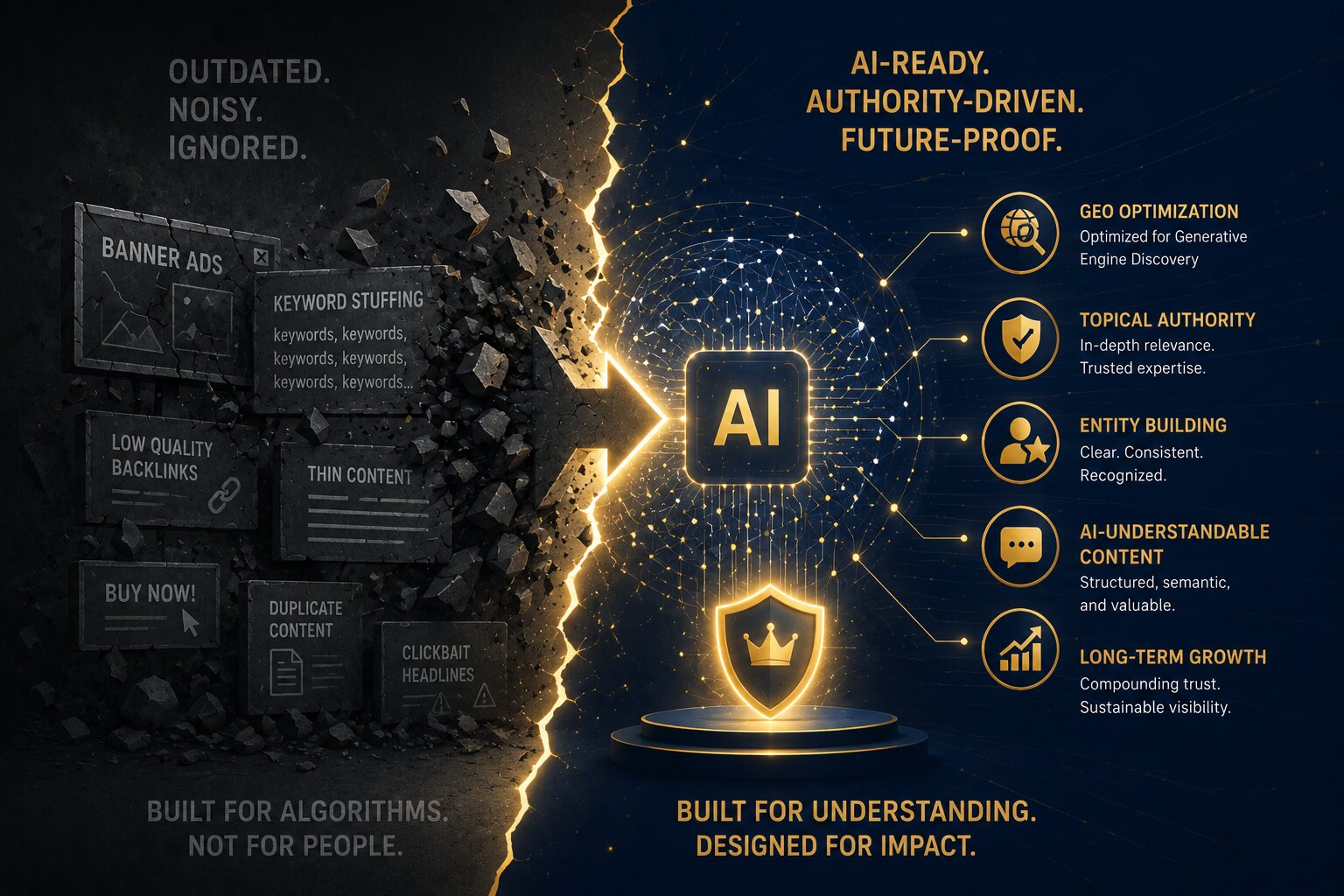
For nearly two decades, digital marketing ran on a predictable engine: publish content, rank on Google, push paid ads, and convert clicks on landing pages. That engine is now being rewritten—fast. The pivotal change is not “another algorithm update.” It is a structural shift in how people discover information, make decisions, and assign trust.
Google itself has openly positioned generative AI as a way for Search to “take the legwork out of searching.” When answers appear directly inside search results (AI summaries, knowledge panels, “zero-click” features), the user’s need to visit your website decreases. The consequence is simple: traffic is no longer guaranteed—even if you are the best answer.
The click economy is shrinking
Multiple independent datasets show the same trend: fewer clicks to the open web.
- Gartner predicts that by 2026, traditional search engine volume will drop 25%, with search marketing losing share to AI chatbots and virtual agents.
- Pew Research (March 2025 analysis) found that when an AI summary appears, users clicked a traditional result in 8% of visits—versus 15% when no AI summary appeared.
- Bain reports that about 80% of consumers rely on “zero-click” results in at least 40% of their searches, reducing organic web traffic by an estimated 15%–25%.
- A Datos + SparkToro analysis (reported June 2025) showed organic click behavior declining year-over-year, with “zero-click” searches rising in both the US and EU/UK.
This is why “more blogs” and “better meta titles” won’t be enough in 2026. The funnel is collapsing at the top—not because people stopped searching, but because search is changing shape.
What replaces traditional digital marketing in 2026
The winners will not be brands that hack distribution. The winners will be brands that engineer authority, experience, and AI discoverability.
1) Authority Engineering (beyond branding, beyond PR)
In a world of AI-generated answers, your brand must become a trusted entity, not just a website.
A practical way to think about it: AI systems cite and summarize what they recognize as credible. That requires consistent signals—clear expertise, authorship, proof, and topical depth.
Gartner’s Alan Antin puts it bluntly: “GenAI solutions are becoming substitute answer engines… [forcing] companies to rethink their marketing channels strategy.”
2) Experience becomes the new conversion engine
Ranking and conversion increasingly correlate with how users behave on your pages and content ecosystems—do they stay, understand, return, share, and search your brand again?
In 2026, the best-performing “SEO” will often look like:
- better information architecture
- clearer comparisons and decision guides
- interactive proof (calculators, checklists, explainers)
- faster pages, simpler UX, fewer distractions
It is not just design polish—it is cognitive load reduction.
3) AI Discoverability (the new SEO layer)
Your content must be legible to:
- Search engines (traditional indexing)
- AI answer systems (summarization + retrieval)
- Users (fast comprehension)
That means writing and structuring content so it can be reliably extracted into answers: strong definitions, clean headings, concise FAQs, evidence blocks, and transparent sources.
The strategic shift: from “Traffic” to “Trust Systems”
Traditional digital marketing optimized for clicks. 2026 marketing optimizes for trust at the moment of decision—even if the decision happens inside an AI interface.
Or, as Seth Godin noted, “the most trusted brand is also the most profitable.”
What you should do immediately
- Build “entity-first” brand assets: founder pages, author bios, expertise hubs, case libraries.
- Convert top pages into answer-ready formats: definitions, FAQs, comparison tables, evidence sections.
- Add proof-of-value: metrics, credentials, process transparency, verifiable outcomes.
- Diversify discovery: YouTube (transcripts), LinkedIn, community platforms, and AI-citable content.
Peer-reviewed and academic reading (external journals)
- Large-scale study comparing generative AI vs traditional search tasks (ACM).
- Survey of conversational search (ACM).
- Study on AI-powered information search behavior.
- Research on generative AI consequences for online knowledge communities (Scientific Reports, Nature Portfolio).

Written by
Dr. Deepika Bahri
Dr. Deepika Bahri is a passionate Branding and Digital Marketing expert with a Doctorate in Marketing, specializing in Brand Strategy and Digital Transformation. With over Two Decades of experience in the media, advertising, and communication industry, she brings a unique blend of academic insight and real-world business acumen. She has also been honored with an Honorary Doctorate for her contribution to Women Empowerment, recognizing her efforts in mentoring, uplifting, and creating platforms for women-led enterprises. Currently serving as the CEO of Antraajaal, a leading branding and advertising agency, Dr. Bahri is committed to sharing insights on branding, marketing strategy, women leadership, and digital growth through her writing and speaking engagements.
Need Expert Guidance?
Antraajaal builds purpose-led brand identities for serious businesses.
Brand strategy, identity and digital presence — one integrated system, built to lead across North India.
Our Services